Dart frog enclosure & care
Dart frogs need at least a 25-gallon enclosure and a steady 72–78°F. They live 8–15 years, and a complete setup costs $309–$634.
- Lifespan
- 8–15 years
- Adult size
- 0.75-2 in (2-5 cm) snout to vent
- Smallest enclosure
- 25 gal
- Diet
- Tiny live insects, calcium supplement
- Handling
- Hands-off: best watched
- First year
- $494–$1,024
What do dart frogs eat?
Strict insectivores requiring tiny live food including flightless fruit flies (Drosophila melanogaster and hydei) and springtails. All feeder insects must be dusted regularly with a high-quality calcium supplement containing Vitamin D3 and Vitamin A.
Food per year: $120–$240
Dart frog temperature & humidity
Warm side
72–78°F
Cool side
68–72°F
- Night
- 65–70°F
- Humidity
- 80–100%
Temperatures exceeding 82°F (28°C) are dangerous and can quickly prove fatal to dart frogs. Maintain continuous high humidity while utilizing a raised drainage layer to keep roots and feet from sitting in waterlogged substrate.
Dart frog enclosure size
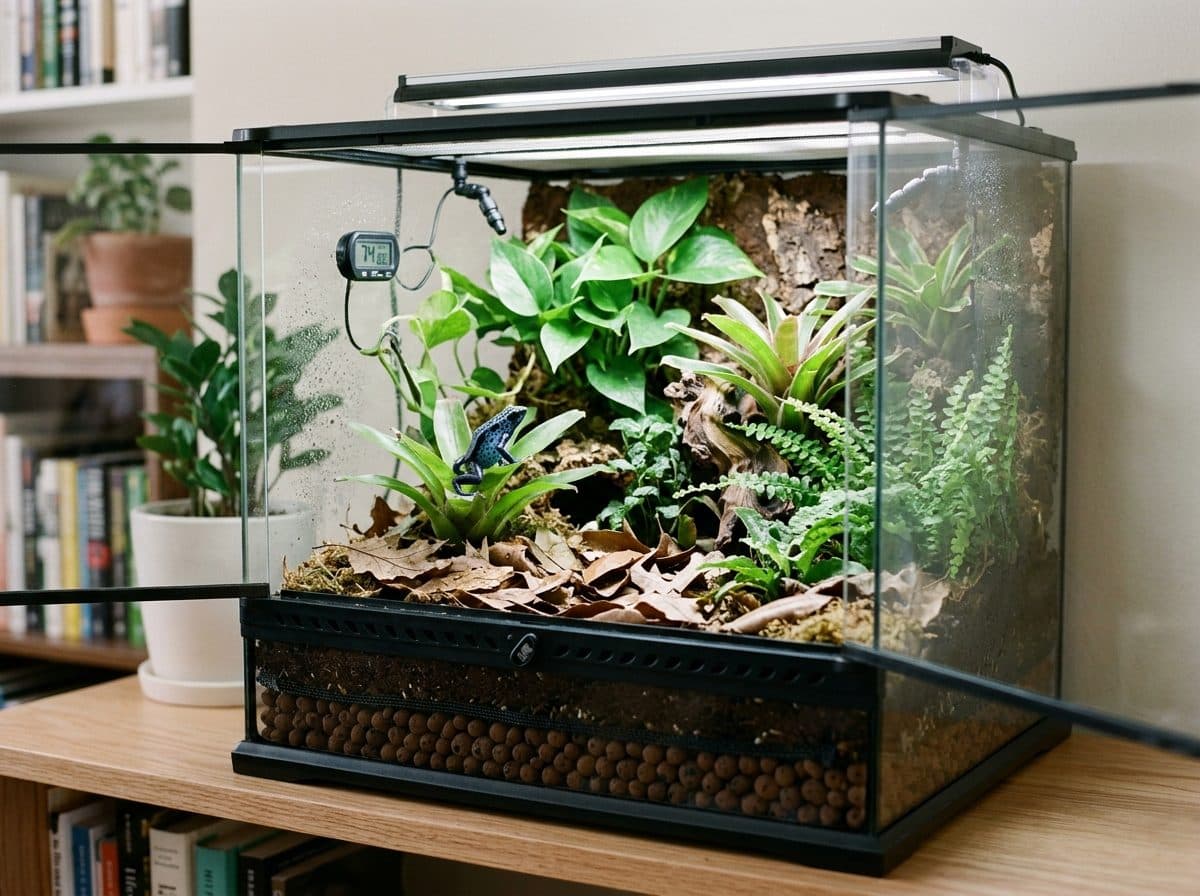
18 × 18 × 18 in (1.5 × 1.5 × 1.5 ft), 25 gallons for an adult. Front-opening glass terrarium with partial glass cover, any orientation.
Young froglets should be started in small grow-out containers (such as 12x12x12 inches) so they can easily locate tiny prey like fruit flies.
Provide at least 10 gallons of volume per frog and house only single-species groups to avoid aggressive territorial conflict or cross-breeding.
Lighting & heat
UVB: Optional low-output UVB (T5 HO 2.4-6% shade-dweller tube); a 6500K LED plant light is essential for the live plants
Heat: Rarely needed if the room stays 68-75°F; don't put heat mats or heat lamps on a dart frog tank, warm the room instead if it gets cold
Day length: 10–12 hours of light
Substrate
Good choices: LECA expanded clay balls for drainage layer; Substrate mesh barrier screen; ABG (Atlanta Botanical Garden) mix; Magnolia or live oak leaf litter layer.
Avoid: Calcium or silica sand; Potting soil containing artificial fertilizers or perlite; Cedar, pine, or aromatic wood chips; Exposed bare drainage material without screen or leaf cover.
What a dart frog needs
Everything for a complete adult setup. Essentials are ticked; untick anything you already have.
How much is a dart frog?
- The dart frog itselfPer captive-bred frog. Common species like D. auratus and D. leucomelas are at the low end; popular tinctorius morphs and thumbnail (Ranitomeya) species cost more.
- $40–$150
- Setup, essentials
- $309–$634
- Every year after
- $185–$390
- First year, setup plus supplies
- $494–$1,024
What you keep buying, per year
| Flightless fruit fly cultures and mediaFruit fly cultures collapse after a few weeks and must be continuously started or purchased to provide a steady supply of live food. | monthly | $120–$240 |
| Vitamin and mineral supplementsOpened powdered supplements lose potency and vitamin stability over time and should be replaced regularly to prevent nutritional deficiencies. | every 6 months | $20–$40 |
| Substrate top-offs and leaf litterLeaf litter breaks down naturally in bioactive vivariums and must be replenished to maintain cover and microfauna habitat. | every 6 months | $25–$50 |
| Distilled or RO water for mistingMisting with distilled or reverse-osmosis water keeps mister nozzles from clogging and the glass free of mineral spots, without chlorine reaching the frogs' skin. | weekly | $20–$60 |
Typical US prices. Vet care isn't included: budget for a check-up with an exotics vet after your pet comes home, and keep an emergency fund.
Are dart frogs good pets?
Yes, for someone ready for the work.
Dart frogs live 8–15 years, need about 5–15 minutes of care a day and cost $185–$390 a year in supplies. They are animals to watch, not hold.
- Handling
- Hands-off: best watched
- Difficulty
- Intermediate
- Daily care
- 5–15 min
- Lives
- 8–15 years
- Before you buy
- Captive-bred dart frogs are legal to keep in most of the US, but Hawaii restricts them and treats unpermitted imports as a serious offense. Always buy captive-bred frogs from a reputable breeder.
Before your dart frog comes home
- 01
4-6 weeks before
Build and cycle the bioactive vivarium
Plants, cleanup crew, and microflora require time to establish and stabilize humidity and nutrient cycles before introduced amphibians arrive.
- 02
1 week before
Start initial fruit fly cultures
Culture starter kits take 1 to 2 weeks to produce dense populations of harvestable adult flies.
- 03
48 hours before
Monitor temperature and automated misting schedules
Verifying that environmental parameters stay consistently between 68-75°F and high humidity without flooding prevents fatal acclimation stress.
- 04
Day one
Transfer frog directly into vivarium and minimize disturbance
Immediate placement into a humid, well-planted enclosure reduces dehydration risk and shipping stress.
- 05
First two weeks
Observe feeding and moisture levels without handling
Allowing the frog to adjust undisturbed ensures it acclimates to hunting in its new environment.
- 06
Within first month
Schedule a baseline health check and fecal exam with an exotics vet
Screening fresh stool for parasites helps catch internal pathogen loads early before symptoms manifest.
Common setup mistakes
- Allowing temperatures inside the enclosure to exceed 80-82°F, which causes lethal heat stress.
- Handling the frogs with bare hands, introducing toxic skin oils, soaps, and lotions to sensitive permeable skin.
- Skipping a functional drainage layer, leading to stagnant, waterlogged soil that causes foot rot.
- Mixing different species or color localities together, resulting in severe territorial aggression or unwanted hybridizing.
- Using untreated tap water containing chlorine or chloramines, which poisons delicate amphibian skin.
Questions people ask
What size tank do I need for poison dart frogs?
A standard 18x18x18 inch front-opening glass terrarium (approx 25 gallons) comfortably houses a pair or small group of 2-3 terrestrial dart frogs. Plan on providing at least 10 gallons of space per frog.
What temperatures do poison dart frogs need?
Dart frogs thrive at comfortable room temperatures between 72°F and 78°F during the day, with a slight drop to 65-70°F at night. Temperatures rising above 82°F can quickly be fatal.
What basic items do I need to set up a dart frog tank?
You need a front-opening glass terrarium, drainage layer with mesh barrier, bioactive soil mix topped with leaf litter, live tropical plants, a 6500K LED plant light, a digital thermometer/hygrometer, and a daily mister or automatic misting system.
How much does it cost to set up a dart frog habitat?
Expect to spend about $310 to $630 on the essentials for a bioactive vivarium (tank, plant light, drainage and substrate layers, plants, cleanup crew, mister, supplements and a fruit fly culture), plus $40 to $150 per frog depending on species.
Sources
The numbers on this page come from these care sheets and references, checked October 2026. How we make these guides.